
History
Band plays part of the march "1914"
With its origins in the late 1800’s, Manly Band has enjoyed a long and illustrious history and a rich heritage upon which it still draws today.
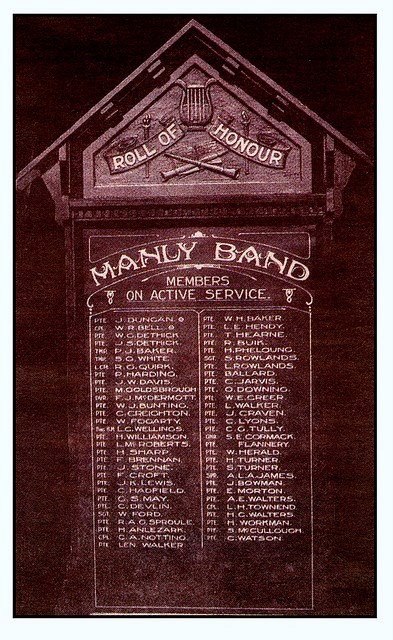
From its participation in the first recruiting march of the Great War, in Manly on the 23rd of August 1915, to its regular concerts and its ongoing role at the head of today’s Anzac Marches, the Band has always been a dedicated contributor to the Manly community.
Band plays part of La Marseillaise
One evening in 1906 a French three masted square rigger, the “Vincennes”, mistaking the lights of Manly for the entrance to Sydney Harbour, ran aground at North Steyne beach. As these dramatic events were unfolding, the Manly Band, fresh from a Sunday concert, had been relaxing at the Steyne Hotel – a fine tradition that the current Band members have felt obliged to maintain!
And so at midnight, the Band – refreshed and civic minded – wandered to the beach and entertained the French with renditions of La Marseillaise, Home Sweet Home and Auld Lang Syne, to reportedly rapturous applause from locals and international visitors alike. History’s a little light on the details here, so one can only hope that the unfortunate French had at least been rescued by this time!
Band plays the last few Bars of Auld Lang Syne
The Manly Band enjoyed its most successful period under the baton of champion trumpeter Jerry Pheloung who, only a year after being appointed to the position, led the Band to be Australasian Champions in 1911 and runners up in 1912 and 1913.
The Great War would see Manly Band disbanded for several years, reforming in 1920, again under Pheloung’s direction.
[It is reported that Manly Band enlisted, virtually en masse, for the Great War. This article from the Manly Library Local Studies Blog provides fascinating information.]
As a tribute to the great contribution of Mr Jerry Pheloung. we’ll play an extract from a popular tune of the day, Hoagy Carmichael’s “Stardust”.
Band plays part of "Stardust"
[Jerry Pheloung’s contribution was also well appreciated by the band members of the day. This article from the Manly Library Local Studies Blog describes a concert given in 1934 in his honour.]
The Band continued to perform through to the late 1950’s, when it was again disbanded, before being re-established in the early 1960’s under the stewardship of the Price family. Llewelyn Price, and his two sons Ron and Clifford, were Welsh immigrants whose musical heritage spanned three generations of brass-banding with the Skewen Band. Along with grandson Stephen Price (the current president of Manly Band), the Price family ensured that the regular Sunday concerts in Manly were no longer a distant memory.
The great ’60s tune A Whiter Shade of Pale perfectly encapsulates this rebirth of the Band.
Band plays Whiter Shade of Pale
The Band flourished under the baton of Cliff Price and president and principle cornet Ron Price – between whom, legend has it, some passionate and robust discussion was had on occasions.
The 1970s saw the Band grow further with Ron and Cliff’s children swelling the ranks and taking the Price clan contribution to a total of nine. In fact, all three of Ron’s sons (Stephen, Graham and Vaughan) still play with the band to this day.
The music of Queen epitomises the 1970’s and Alan Catherall’s arrangement of Bohemian Rhapsody is both a tribute to this golden age of Manly Band and our feature piece today.
The Band continued to perform through to the late 1950’s, when it was again disbanded, before being re-established in the early 1960’s under the stewardship of the Price family. Llewelyn Price, and his two sons Ron and Clifford, were Welsh immigrants whose musical heritage spanned three generations of brass-banding with the Skewen Band. Along with grandson Stephen Price (the current president of Manly Band), the Price family ensured that the regular Sunday concerts in Manly were no longer a distant memory.
The great ’60s tune A Whiter Shade of Pale perfectly encapsulates this rebirth of the Band.
Band plays Bohemian Rhapsody
We hope that you’ve enjoyed today’s music selection and this short history of our longstanding ensemble.